For example, in California, 53% of most likely citizens back single-payer however support drops to simply 41% when they are informed it will require brand-new taxes. Instead, let's expand on a strategy from the ACA: cap out-of-pocket expenses based upon earnings no matter where the individual gets insurance. This cap can be used in Medicare, Medicaid, and private insurance so that no middle-class individual would pay more than 10% of their earnings on health care costs.
Those unions require to be comprised of individuals who utilize and pay for their health care. A massive union of customers, unions, employers, small companies, guvs, and prepared individuals of the health care industry are required to conquer opposition to change. The kernels of such a coalition are offered through Customers First, which is focused on realigning health care rewards to lower expenses and improve quality.
A specialist on the Vermont single-payer strategy stated, "If you can't do it in Vermont, with one private health strategy and low uninsured rates, then the amount of interruption you would have nationally with winners and losers would be massive. how to start a home health care business."38 Some people in this country get totally free or extremely marked down care through Medicaid and the ACA exchanges.
Instead of making them worse off, Congress needs to concentrate on the millions of individuals who are eligible free of charge and discounted care and make certain they are registered through auto-enrollment or one-click simplified registration procedure. And all low- and middle-income families need to get security from high costs based on their income.

With 29 million uninsured and 10s of millions more worried about health care costs, the nation does not have time to squander on policies that will not go anywhere. Instead, let's strengthen the ACA, control expenses, construct strong unions, and attain universal protection. In 2017, Wood spoke at a Bernie Sanders press conference on universal health care. This previous June, she affirmed at a congressional hearing on universal health coverage. She now works full-time for Mass-Care, a Massachusetts-based not-for-profit promoting for Medicare for All. Not every single-payer advocate's story is as heartbreaking as Wood's.
In 2016, it was the special quirk of Sanders's candidateship; now 11 candidates support some variation of it. Single-payer health care, the kind that exists in Canada and some European countries, would make medical care totally free or nearly complimentary for all Americans. Under some versions of these strategies, private insurance coverage would be removed, and all Americans would be covered under one, government-run strategy, comparable to Medicare.
A Biased View of What Is Health Care Reform
Most either have or just recently had health insurance coverage, but they state it wasn't enough to Find more information protect them or their member of the family from death, disease, or debt. Medicare for All strikes lots of as the simplest way to stop the health-care insanity, even if the political path to it isn't yet clear.
In such a way, the rallying cry of single-payer harkens back to President Barack Obama's use of, in the dark days of the 2008 economic downturn, uplifting slogans like "Hope," "Change," and "Yes, we can." Many people didn't understand precisely how "hope" would lead us out of economic gloom. But simply as with health care today, they were quite sure it couldn't get any even worse.
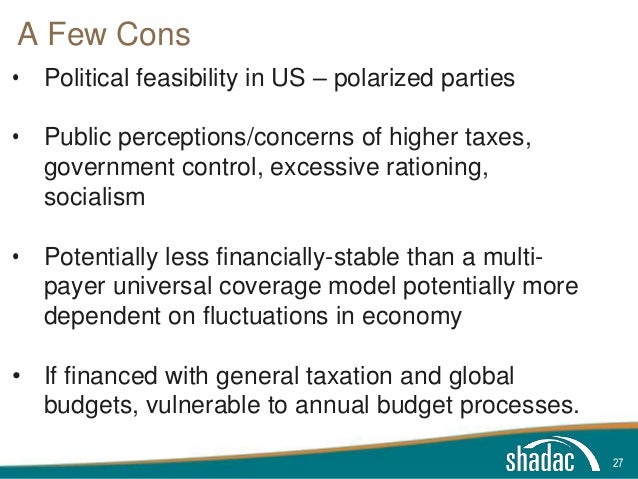
Numerous moderate Democrats and many conservatives stay staunchly opposed to any sort of single-payer plan. Former Vice President Joe Biden, who supports more incremental health reforms, has stated Medicare for All would raise taxes on the middle class. Numerous Democrats are uneasy about dismantling the personal health-insurance market, and they stress about how such a sweeping program would be funded.
Marie Fishpaw, the director of domestic-policy research studies at the Heritage Foundation, a conservative think tank, disagreements that Medicare for All is even all that popular. (Assistance for Medicare for All has declined somewhat given that 2017.) "While polls reveal preliminary assistance for Medicare for All, there is an amazing drop in support when individuals learn more about the details," she informed me via e-mail.
A bulk of Americans continue to state the federal government has a responsibility to make sure all Americans have healthcare protection (what is health care policy). And because in 2015, there has been a boost particularly among Democrats in the share stating health insurance coverage need to be supplied by a single nationwide program run by the government.
For this analysis, we carried out an online survey of 11,001 U.S. adults between July 27 and Aug. 2, 2020. Everybody who took part is a member of the Center's American Trends Panel (ATP), an online study panel that is recruited through nationwide, random tasting Go to this website of residential addresses. This method nearly all U.S.
Which Of The Following Represents The Status Of A Right To Health Care In The United States? Can Be Fun For Everyone
The survey is weighted to be representative of the U.S. adult population by gender, race, ethnic culture, partisan affiliation, education and other classifications. Find out more about the ATP's methodology. Here are the concerns used for this report, along with responses, and its methodology. Amongst the public total, 63% of U.S. adults say the government has the duty to supply health care coverage for all, up slightly from 59% last year.
2 amongst 11,001 adults. When asked how the federal government should supply health insurance protection, 36% of Americans state it must be supplied through a single national government program, while 26% say it ought to continue to be provided through a mix of personal insurance companies and government programs. This is a change from about a year ago, when almost equivalent shares supported a "single payer" health insurance coverage program (30%) and a mix of government programs and private insurance companies (28%).
A 54% majority of Democrats and Democratic leaners now favor a single national federal government program to provide health insurance, up from 44% last year. Support for single payer health coverage has increased among many groups of Democrats, consisting of those who explain their political consider as extremely liberal (up from 66% to 77%), liberal (50% to 61%) and conservative or moderate (35% to 43%).
Amongst the one-third of Republicans who say the federal government does have this responsibility, viewpoint is divided over whether or not it should be supplied through a single government program or a mix of private and government programs. Although the majority of Republicans state it is not the federal government's duty to make sure health coverage for all, a 54% bulk says the federal government "should continue to supply programs like Medicare and Medicaid for elders and the extremely bad." Just 11% of Republican politicians say the federal government must not be included at all in supplying medical insurance.
Very liberal Democrats, who in 2019 made up 15% of Democratic registered citizens, are even more most likely than liberal Democrats (32% of Democrats) and moderates and conservatives (51%) to say that medical insurance ought to be supplied by a single government program. White Democrats stay most likely than those of other races and ethnicities to support a single national program, however White, Black and Hispanic Democrats have each increased their assistance for a single nationwide program by about 10 percentage points since in 2015.
With a system that is extremely based on employer-based, for-profit medical Rehabilitation Center insurance, countless Americans have no or insufficient protection. The patchwork of expensive, unequal insurance strategies has actually contributed to bankruptcy, homelessness, preventable disease, and death. Inflated insurance coverage and health care expenses position unfair demands on services and taxpayers. By making high-quality healthcare for all as cost-effective as possible, a single-payer system satisfies the health requirements of the public and contributes to a healthy economy.
Some Known Details About A Health Care Professional Is Caring For A Patient Who Is About To Begin Using Betaxolol
You and your doctor decide what is best for you. You take the medications that you and your doctor concur are suitable for you. Insurance companies presently impose restrictions on the kinds and amount of care covered. Such constraints disrupt the rights of medical professionals and clients to choose care based upon an individual's needs.
A single-payer system enables option of licensed healthcare specialists and certified facilities and instantly covers all medically essential care, with a concentrate on preventive care. It consists of alternatives supported by proof, including chiropractic practitioner and acupuncture services, and gives equal consideration to physical and mental health requirements. Choices on treatment are delegated the patients and their physicians.